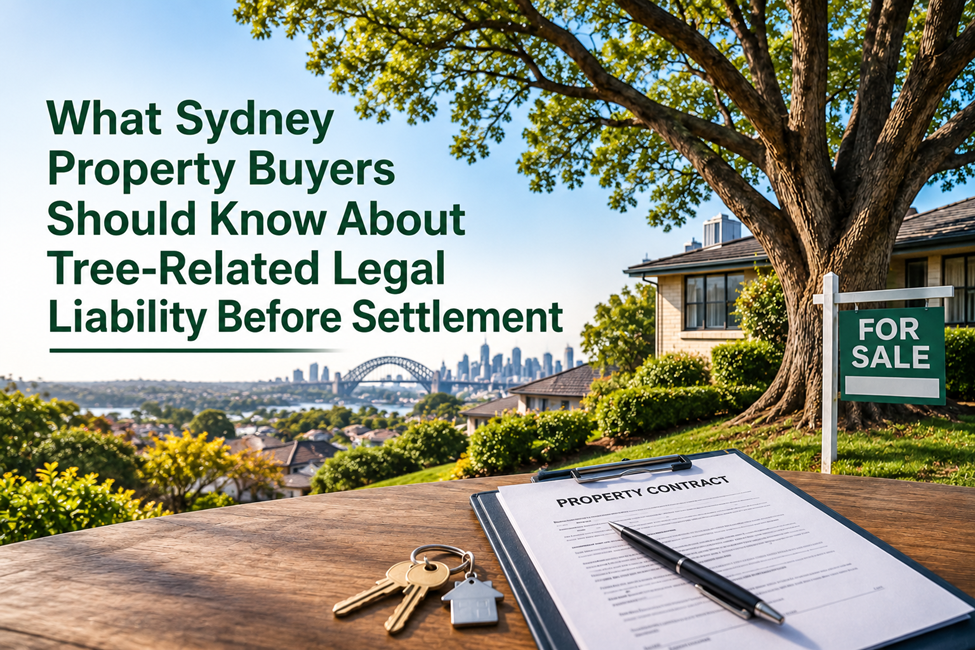
Most Sydney buyers spend months poring over building reports, strata minutes and pest inspections, then walk straight past the big gum tree in the back corner without a second thought. It’s understandable that trees are part of the scenery, not the paperwork. But a mature tree close to a house, a root system pushing up a driveway, or an unresolved argument with the neighbour next door can turn into a genuine cost, safety issue or legal headache once you’re the one holding the title.
This isn’t about scaring buyers off leafy blocks. Sydney’s tree canopy is one of the things that makes many suburbs worth living in. It’s about treating significant trees the same way you’d treat an ageing roof or a shared driveway: as something worth understanding before you sign, not after.
Can Trees Create Legal Liability for a Sydney Property Owner?
In short, yes, in certain circumstances, though not automatically and not for every tree on every block.
Whether a property owner ends up legally or financially responsible for a tree-related problem generally depends on a combination of factors, including:
- where the tree is located relative to the boundary and any structures
- the tree’s condition and whether any risk was foreseeable
- whether the tree has caused (or is likely to cause) damage or injury
- the history of the relationship with any affected neighbour
- whether council tree controls applied to the tree
- which piece of NSW legislation is relevant to the situation
- whether any prior warnings, notices or complaints existed
A property owner isn’t automatically liable simply because a tree on their land falls or drops a branch. Liability questions in this area tend to turn on whether the risk was known or reasonably foreseeable, and what (if anything) was done about it. That’s a legal assessment, not a guess and it’s one reason buyers shouldn’t try to self-diagnose a serious dispute without proper advice.
Why Tree Issues Matter Before Property Settlement
Trees rarely show up on a standard building and pest inspection in any detail, which means a buyer can complete a purchase without ever having a professional look closely at a large tree sitting metres from the house. A few reasons this is worth changing:
Unexpected costs. Removing or significantly pruning a large, mature tree in Sydney is rarely cheap, particularly if council approval, traffic management or crane access is involved.
Safety. A tree with dead limbs, visible trunk damage or a pronounced lean close to a dwelling, driveway or where people regularly walk is a genuine risk, not just an aesthetic issue.
Existing damage. Roots can already be affecting paving, retaining walls, drainage or even footings by the time a buyer inspects the property, and the visible cracking might be the tip of the problem.
Neighbour disputes. A previous owner may have been mid-argument with next door over overhanging branches or root damage, a dispute a new owner can effectively inherit.
Council restrictions. A tree the buyer assumes can simply be removed after settlement may in fact be protected, meaning removal isn’t straightforward or may not be possible at all.
Insurance considerations. Some insurers ask about known tree risks or may query claims linked to a tree the owner knew, or should have known, was hazardous.
Future renovation plans. A significant tree close to where a buyer wants to extend, build a pool or add a driveway can affect what’s achievable, and when.
None of this means every property with trees is a problem property. It simply means trees deserve a place on the due diligence checklist alongside the building report and the strata search.
What Happens If a Tree Is Already Causing Problems Before You Buy?
Settlement doesn’t wipe the slate clean on a tree issue. If a tree was already causing damage, was the subject of a neighbour complaint, or had council correspondence attached to it before a buyer purchased the property, that history generally doesn’t disappear just because ownership changes hands.
This matters in a few practical ways. Under the Trees (Disputes Between Neighbours) Act 2006 (NSW), orders made by the NSW Land and Environment Court in relation to a tree can, in some circumstances, continue to bind successors in title where the required work hasn’t yet been carried out. In other words, a court order obtained against a previous owner may still have consequences for the next owner if it was never actioned.
Buyers should be alert to signs of a live or recent issue, including:
- existing complaints from a neighbour, verbal or written
- previous correspondence from the council about a specific tree
- unresolved property damage that appears linked to a tree
- an arborist report commissioned by the seller or a neighbour
- any development or removal applications lodged but not finalised
- any reference to legal proceedings, mediation or a Land and Environment Court application
If any of these come up during a sale whether through a vendor disclosure, a conversation with the agent, or something noticed on inspection it’s worth raising it with your conveyancer or solicitor before exchanging contracts, not after.
Tree Damage, Roots and Falling Branches
Tree-related property damage in Sydney generally falls into a handful of recurring patterns:
- roots lifting or cracking paving, driveways and paths
- root intrusion affecting drainage pipes or stormwater lines
- root pressure on retaining walls or shallow footings
- branches damaging fences, roofs, gutters, pergolas or parked cars
- falling limbs or entire trees during storms, particularly from trees already in poor health
A common misconception is that responsibility for tree damage is simply decided by which side of the boundary the tree happens to be growing on. That’s not quite right. Whether a property owner is responsible for damage caused by their tree or whether a neighbour has a claim depends on the specific facts, the relevant legislation, and in many cases what a court decides was reasonably foreseeable. Where there’s genuine damage or an unresolved dispute involving a tree, it’s worth getting proper legal advice rather than relying on general assumptions about “whose tree, whose problem.”
What If the Tree Belongs to a Neighbour?
It’s a common scenario in established Sydney suburbs: the tree causing the concern isn’t even on the property being purchased, it’s next door.
In broad terms, a property owner generally has some rights in relation to branches or roots that cross the boundary onto their land, though this doesn’t extend to entering a neighbour’s property or carrying out tree work without permission; doing so can create its own legal and safety problems. Where a tree on a neighbour’s land is causing, or is likely to cause, damage or injury, the Trees (Disputes Between Neighbours) Act 2006 sets out a process for resolving the dispute through the NSW Land and Environment Court. Most disputes don’t end up there; many are resolved through direct communication between neighbours, a shared arborist assessment, or informal mediation but the Court exists specifically for the cases that can’t be sorted out amicably.
If a buyer becomes aware of an existing or brewing dispute involving a neighbour’s tree, the sensible first steps are to document what’s been observed, avoid any DIY tree work across the boundary, and raise it with a solicitor or conveyancer as part of due diligence.
Protected Trees and Council Approval in Sydney
One of the more common surprises for new Sydney property owners is discovering that a tree they assumed could simply be removed is actually protected under the local council’s Tree Preservation Order (TPO) or equivalent controls in the council’s Development Control Plan.
Most Sydney councils require approval before a tree above a certain size, species or significance can be pruned or removed on private residential land. Rules commonly cover:
- minimum trunk diameter or height thresholds that trigger approval
- specific protected or significant tree registers
- heritage conservation areas, where additional controls may apply
- exemptions for certain species, dead or clearly hazardous trees, and noxious weeds
- the process for applying for consent, and the evidence typically required (often including an arborist report)
Crucially, these rules vary between local government areas. A tree removal exemption that applies in one council area won’t necessarily apply in the next suburb, even a few streets away. Buyers should never assume a tree can be removed without approval simply because a similar tree was removed elsewhere. The only reliable way to know what applies to a specific property is to check with the relevant council directly, or have this confirmed as part of due diligence.
Carrying out unauthorised work on a protected tree can carry meaningful penalties, so this is one area where it genuinely pays to check before, not after.
Should You Get an Arborist Inspection Before Settlement?
Not every property needs a pre-purchase arborist inspection. A small ornamental tree well clear of any structure is unlikely to warrant one. But a dedicated arborist assessment can be genuinely worthwhile where:
- the property has one or more large, mature trees
- trees are growing close to the house, garage, pool or boundary fence
- a tree looks unhealthy, sparse, or has significant dead wood
- there’s visible trunk damage, cavities, fungal growth or a noticeable lean
- roots appear to be affecting paving, retaining walls or drainage
- a neighbour has already raised a concern about a tree on the property
- the seller mentions previous pruning, cabling or tree removal work
- the property sits in an area with strict tree preservation controls
A qualified, AQF-certified arborist can assess a tree’s structural condition, health, likely lifespan and immediate risk factors, and can identify whether more detailed testing (such as root investigation or aerial inspection) is warranted. What an arborist won’t do is provide a legal opinion; their report speaks to the tree’s condition and risk, not to who is legally responsible if something goes wrong. For buyers weighing up whether a pre-purchase inspection makes sense, engaging an experienced arborist Sydney buyers can rely on is generally a modest cost next to the price of the property itself, and the peace of mind or early warning it provides.
What Documents Should a Buyer Ask About?
Where significant trees are part of a property, it’s reasonable to ask the seller or agent whether any of the following exist:
- arborist reports or tree risk assessments
- correspondence from the council relating to any tree on the property
- approvals or consents for previous tree removal or pruning work
- development approvals that reference trees or landscaping conditions
- any written correspondence with neighbours about tree-related concerns
- invoices for tree work, root barrier installation or drainage repairs
- insurance correspondence connected to tree damage
- copies of any notices, orders or Land and Environment Court documents
Not every document will exist, and their absence isn’t necessarily a red flag. But where documents do exist and touch on legal or contractual matters, they should be reviewed by your conveyancer or solicitor, not just read over informally. A solicitor can assess whether anything needs to be raised with the seller, reflected in special conditions, or investigated further before exchange.
Questions to Ask Before Buying a Sydney Property With Large Trees
A short, practical list to work through with the agent, seller or your own inspections:
- Are there any known tree disputes involving this property?
- Has the council ever sent correspondence about a specific tree here?
- Has any significant tree work been carried out recently?
- Was council approval required and obtained for that work?
- Has an arborist ever inspected the trees on this property?
- Has any tree caused damage to structures, fences or paving?
- Have neighbours raised concerns about branches, roots or shading?
- Are there any current or previous legal proceedings involving a tree?
- Are there signs of structural or drainage problems near large trees?
- Could significant trees affect future renovation or extension plans?
What Buyers Should Do If They Discover a Tree Problem Before Settlement
If something concerning comes up during inspections or negotiations, a sensible sequence looks like this:
- Document what you’ve found, photos, dates, and a written note of what was observed or said.
- Get professional arboricultural advice where the issue relates to a tree’s health, stability or risk.
- Check with the relevant council to understand what controls, if any, apply to the tree.
- Tell your conveyancer or solicitor as soon as practical earlier is always better than after exchange.
- Review the contract and any disclosure documents with your solicitor for relevant conditions or omissions.
- Ask the seller or agent for clarification and documentation where gaps exist.
- Consider whether further inspections are needed before you’re comfortable proceeding.
- Try to resolve material issues before settlement, where that’s realistically possible.
This is general guidance rather than a substitute for advice tailored to your specific contract and circumstances every situation is different, and a solicitor or conveyancer is best placed to advise on what a particular finding means for your purchase.
How an Existing Tree Dispute Could Affect a Property Purchase
An unresolved tree issue doesn’t necessarily kill a deal, but it can have real, practical consequences:
- delays while further advice or documentation is obtained
- additional costs for arborist reports, legal advice or council applications
- repair costs for existing root or branch damage
- ongoing maintenance obligations the buyer wasn’t expecting
- strained relations with a neighbour from day one of ownership
- restrictions on what tree work can be carried out, and when
- in more serious cases, the possibility of Land and Environment Court proceedings
- flow-on effects for insurance or future renovation plans
The scale of these consequences varies enormously; a minor overhanging branch is a very different proposition to a mature tree with a history of dropping limbs onto a shared driveway. Each situation genuinely needs to be looked at on its own facts.
A Practical Pre-Settlement Tree Due Diligence Checklist
- [ ] Identify all significant trees on the property
- [ ] Look for visible signs of poor tree health (deadwood, sparse canopy, fungal growth)
- [ ] Note any large trees close to the house, garage, pool or boundary
- [ ] Check for signs of root-related damage to paving, walls or drainage
- [ ] Ask the seller or agent about previous tree work
- [ ] Ask whether any tree disputes, past or present, are known
- [ ] Check the relevant council’s tree preservation requirements
- [ ] Request any existing arborist reports
- [ ] Raise known issues with your conveyancer or solicitor before exchange
- [ ] Consider an independent arborist assessment for higher-risk properties
- [ ] Keep copies of all relevant documentation
For buyers who uncover a genuine concern and want a second opinion or ongoing management plan, it’s worth taking the time to contact a professional tree care team who can advise on condition, maintenance and next steps ahead of settlement.
Final Takeaway for Sydney Property Buyers
Trees should be treated as part of property due diligence, not simply landscaping. That doesn’t mean every mature gum, fig or jacaranda needs an arborist report before you can safely exchange contracts; most trees are exactly what they appear to be: an asset, not a liability. But where a property has significant trees close to structures, a tree in visibly poor condition, or any hint of an existing dispute or council correspondence, it’s worth a closer look before settlement rather than after.
A modest amount of extra checking now, a conversation with the agent, a question to your solicitor, or an arborist’s opinion on a tree that looks doubtful is a lot cheaper than discovering a problem once the keys are already in your hand.
Frequently Asked Questions
1. Can a tree create legal liability for a new property owner in NSW?
It can, depending on the circumstances. Liability generally depends on factors such as the tree’s condition, whether any risk was foreseeable, where the tree is located, and whether relevant council or legislative requirements were followed. It isn’t automatic simply because a tree is on your land, but where damage or injury results, responsibility can come into question. Speak to a solicitor if you’re facing a specific situation.
2 .Should I get an arborist inspection before buying a Sydney property?
It’s worth considering where a property has large or mature trees, trees close to buildings, or any visible signs of poor health, damage or instability. A qualified arborist can assess a tree’s condition and risk, though they can’t provide legal advice on liability. For lower-risk properties with small, healthy trees well clear of structures, a dedicated inspection may not be necessary.
3. What happens if a tree is already damaging a neighbour’s property before settlement?
Existing damage or disputes don’t automatically disappear at settlement. In some cases, orders made under the Trees (Disputes Between Neighbours) Act 2006 can continue to affect a property even after it changes hands, particularly where required work hasn’t been completed. Any known issue should be raised with your conveyancer or solicitor before you exchange contracts.
4. Can I remove a tree after buying a property in Sydney?
Possibly, but not automatically. Most Sydney councils require approval before a tree above a certain size or significance can be removed or heavily pruned, and rules vary between local government areas. Always confirm requirements with the relevant council, and get professional arboricultural advice, before assuming a tree can simply come down.
5. Who should I speak to about a tree-related legal issue before settlement?
It depends on the nature of the issue. An arborist can assess a tree’s health, structure and risk. Your local council can confirm what approvals or protections apply. Your conveyancer or solicitor should be your first call for anything with legal or contractual implications, including how a known tree issue might affect your contract or settlement.
This article provides general information only and is not legal advice. Tree-related rights and obligations in NSW can depend on the specific property, council area, tree location and circumstances involved. Buyers with a specific concern should seek advice from a qualified conveyancer, solicitor, or arborist as appropriate.