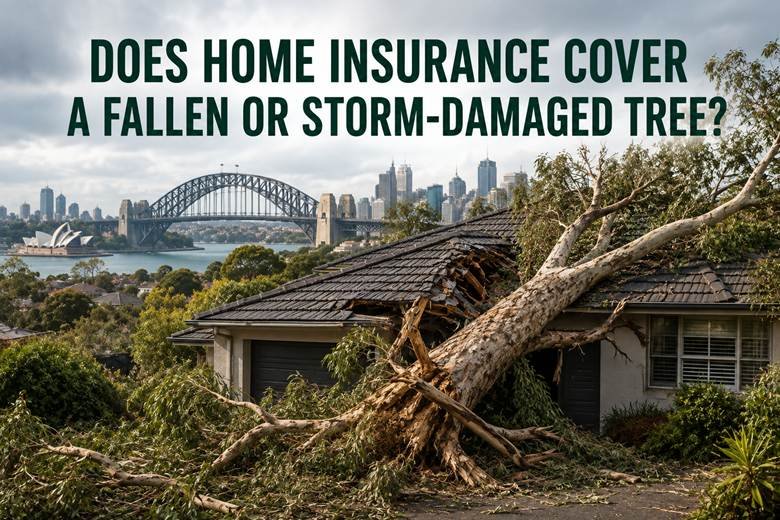
Home insurance may cover damage caused by a fallen or storm-damaged tree, but it depends on your policy wording, why the tree came down, what it damaged, and any exclusions that apply. Most Australian insurers treat a falling tree as an “impact” event, which is usually an insured event under home and contents policies. What they pay for after that, though, can vary a lot.
If a gum tree has just come down across your roof or a neighbour’s Jacaranda has flattened your fence, you probably don’t want a legal essay. You want to know what to do right now, and whether you’re about to be out of pocket. This guide walks through both.
Does Home Insurance Cover a Fallen Tree?
Yes, in most cases if the tree damaged an insured structure. Home and contents insurers generally classify a falling tree as an “impact” event, which sits alongside things like a falling branch, a vehicle hitting a fence, or debris blown by wind. If that impact damages your home, garage, shed, or contents, it’s typically covered under your policy’s insured events.
The tricky part is what “covered” actually includes. There are several separate things that can happen when a tree falls, and a policy doesn’t necessarily treat them the same way:
- Damage to your home roof, gutters, walls, windows is usually covered under building insurance.
- Damage to other insured structures on the property, such as a carport, shed, garage, retaining wall, or fence, is often covered, though fencing sometimes has its own sub-limit.
- Damage to contents, like furniture or electronics ruined when a tree punches through a roof, generally falls under contents insurance rather than building insurance.
- Removing the tree itself is treated separately again, and is usually only covered where it caused the damage in the first place.
- Damage caused by an insured event, such as a severe storm, cyclone, or lightning strike bringing the tree down, is more likely to be covered than damage from a tree that fell for unrelated reasons, like poor health or old age.
None of this is guaranteed across every insurer or every policy. The only way to know exactly what applies to your situation is to read your Product Disclosure Statement (PDS) or call your insurer directly.
Does Home Insurance Cover Storm-Damaged Trees?
Generally, yes, storm damage is one of the more clear-cut scenarios insurers cover, because a severe storm is usually an “insured event” in its own right, separate from the general “impact” category. When wind, rain, or lightning brings a tree down and it damages your property, most standard home insurance policies respond.
That said, “storm” has a specific meaning in many PDS documents, and insurers can look closely at circumstances before accepting a claim. Things that can affect the outcome include:
- Whether the weather event meets the policy’s definition of a storm (some insurers reference wind speed or the Bureau of Meteorology’s severe weather warnings).
- Whether the tree was already dead, diseased, or known to be unstable before the storm, insurers may query claims where poor tree maintenance appears to be the real cause.
- Whether the damage happened during the storm window specified in your claim, since insurers sometimes ask for supporting evidence like weather records.
If you’re claiming after a storm, it helps to note the date and approximate time the tree came down, and to check whether the Bureau of Meteorology or your local council issued any warnings for your area that day.
What Damage From a Fallen Tree May Be Covered?
Coverage generally depends on what was damaged and whether it’s specifically insured under your policy. Common examples homeowners ask about include:
| What was damaged | Typically covered by |
| Roof, ceiling, walls | Building insurance |
| Fences | Building insurance, sometimes with a sub-limit |
| Garage, shed, carport | Building insurance (if listed as an insured structure) |
| Driveway or paving | Building insurance in many policies, but check exclusions |
| Furniture, electronics, belongings | Contents insurance |
| Parked car | Comprehensive car insurance, not home insurance |
A few things trip people up here. Driveways and paths are sometimes excluded or capped, particularly for cracking caused by tree roots rather than a direct impact. Vehicles are almost always a car insurance matter, not a home insurance one, even if the tree was on your property. And detached structures like garden sheds or pergolas are only covered if they’re actually listed on your policy as insured structures, so it’s worth checking your schedule of cover rather than assuming everything on the block is included.
Does Insurance Pay for Tree Removal After a Storm?
This is where a lot of confusion comes from, because there are really two different jobs after a tree falls: removing the tree, and repairing whatever it is damaged. Insurers tend to treat these as separate questions.
Repairing the damage the tree caused to your roof, fence, or contents is usually covered as part of a standard claim, assuming the cause is an insured event.
Removing the tree is often only covered to the extent needed to access and repair the damage, or to make the property safe. Many policies include a “removal of debris” benefit, but it can come with a dollar limit, and it’s frequently tied to the tree having actually caused damage. If a tree falls in your yard and misses the house entirely, its removal may not be covered at all, since there’s no insured damage to justify the cost.
A few conditions insurers commonly attach to tree removal:
- The removal has to relate to a tree that has already fallen or is imminently dangerous, not general garden maintenance.
- There may be a maximum payout for debris removal, separate from your main sum insured.
- Stump grinding or removing the root ball afterwards is sometimes excluded, even where the tree itself was removed under the claim.
Because this varies so much between insurers, it’s worth asking directly: “Does my policy cover tree removal, and is there a limit?” before assuming the cost is included.
What If My Neighbour’s Tree Falls on My Property?
This is one of the most common and most misunderstood scenarios. The short version: your own home insurer is usually still the right first call, and fault isn’t automatically assumed just because the tree belonged to someone else.
In NSW, a few different things can be relevant:
- Whose land the tree was on. In NSW, a tree is generally treated as belonging to the owner of the land it grows on, and that owner is responsible for its condition.
- Whether the tree was healthy or visibly dangerous beforehand. If a tree was healthy and came down purely because of a severe storm, it’s less likely a neighbour would be found negligent, because the event was largely unforeseeable. If the tree was already dead, split, or had been flagged as a risk for example, if you’d previously raised concerns with the neighbour that can be a different story.
- Whether there’s a negligence case. Under general negligence principles, a property owner can potentially be liable if they knew, or reasonably should have known, that a tree posed a risk and didn’t act on it. This is assessed case by case and isn’t something a homeowner can determine on the spot.
- The Trees (Disputes Between Neighbours) Act 2006 (NSW). This legislation lets the NSW Land and Environment Court hear disputes about trees between neighbours, including claims for compensation where a tree has caused damage. It’s a formal legal process, generally used when a dispute can’t be resolved directly or through insurers.
In practice, most homeowners claim through their own insurer first, regardless of whose tree fell. Your insurer may then pursue recovery from the neighbour’s insurer if there’s a negligence case, which is a process that happens between insurers rather than something you need to argue yourself. Don’t assume your neighbour, or their insurer, is automatically responsible and equally, don’t assume they’re off the hook. This is a genuine grey area, and if the damage is significant or the relationship is strained, it’s worth getting advice from your insurer or a solicitor rather than guessing.
What If a Tree Falls Without Damaging the House?
If a tree comes down in the yard but doesn’t touch your home or any other insured structure, it’s often not covered at all because there’s no insured damage for the policy to respond to.
This catches people out, especially with large old trees that take up a lot of yard space when they fall. Many standard home insurance policies are built around damage to insured buildings and contents, not general garden clean-up. Removing a tree that fell harmlessly in the lawn is frequently treated as a homeowner’s own cost, the same way mowing the lawn or pruning a hedge would be.
There are exceptions. Some insurers offer optional cover, or include limited allowances, for removing a tree that’s become a safety hazard even without direct property damage for instance, if it’s blocking a driveway or leaning dangerously toward a structure. This isn’t standard across the industry, so it’s genuinely a “check your PDS” situation rather than something with a single answer.
What Should You Do After a Tree Falls During a Storm?
Safety comes first, documentation second, and repairs come after that. Here’s a practical order of operations:
- Stay away from dangerous areas. Don’t walk under a leaning tree, a hanging branch, or anywhere the ground looks unstable. Trees can continue to shift or drop limbs well after they first fall.
- Check for immediate hazards. Look (from a safe distance) for gas smells, structural damage that looks unstable, or anything that suggests the situation could get worse.
- Never approach fallen power lines. Always assume a downed line is live, stay at least 8 metres away, and call your electricity distributor immediately Ausgrid, Endeavour Energy, or Essential Energy, depending on your area or 000 if anyone is in immediate danger.
- Photograph and document the damage where it’s safe to do so. Wide shots of the whole scene and close-ups of specific damage are both useful. Note the date, approximate time, and weather conditions.
- Contact your insurer as soon as practical. Most insurers have 24-hour claims lines, particularly during major storm events, and can advise on next steps, emergency repairs, and any temporary accommodation support if your home is unliveable.
- Take reasonable steps to prevent further damage, if it’s safe. This might mean placing a tarp over an exposed roof section. Keep receipts for anything you buy to do this, since insurers often reimburse reasonable temporary repair costs.
- Arrange a professional assessment or removal if the tree is hazardous. Leaning trees, split trunks, or trees resting on power lines need a qualified arborist or tree removal company, not a DIY effort.
- Keep every invoice, report, and photo. You’ll want these on hand when you lodge or follow up your claim.
When Should You Call an Arborist After Storm Damage?
Call a qualified arborist whenever a tree looks structurally compromised, even if it’s still standing. Storm-affected trees aren’t always obviously dangerous, and some of the biggest risks are the ones that look stable from a distance.
Situations that generally warrant a professional assessment include:
- Split or cracked branches, even if they haven’t fully broken off
- Large limbs hanging or caught in the canopy
- Trees that have been uprooted or are visibly leaning more than before
- A trunk with a visible split, crack, or bark tear
- Any tree resting against, or threatening, a structure
- Trees near power lines or other infrastructure
- Trees that “look fine” but were close to a severe wind event and haven’t been checked
Storm-damaged trees, and hazardous tree work generally, should be handled by appropriately qualified and insured professionals rather than attempted as a DIY job; the risks around chainsaws, height, and structural instability are real. If you’re in Sydney and need a professional opinion or safe tree removal Sydney service after a storm, an arborist can assess whether a tree needs removal, pruning, or just monitoring.
How to Prepare for a Tree-Related Insurance Claim
Good documentation makes claims faster and reduces back-and-forth with your insurer. It’s worth keeping a simple folder physical or digital with:
- Photos and videos of the damage, taken as soon as it’s safe
- The date and approximate time of the storm or incident
- A written note of what happened, in your own words, while it’s fresh
- Your insurance policy number and any claim reference once lodged
- An arborist report, if one was obtained
- Invoices for tree removal or emergency repairs
- Repair quotes or estimates
- Copies of any emails, letters, or call notes from your insurer
An arborist report isn’t automatically required for every claim. Some insurers ask for one in specific circumstances for example, to confirm whether a tree was diseased before it fell, or to establish that removal was necessary for safety. Whether you need one depends on your insurer and the specifics of your claim, so it’s worth asking early rather than assuming either way.
How Much Does Storm-Damaged Tree Removal Cost?
There’s no single national price for tree removal, because the cost depends on a long list of variables specific to each job. Rather than quoting a figure that won’t apply to most readers, it’s more useful to understand what actually drives the cost up or down:
- Tree size height and trunk diameter significantly affect time, equipment, and labour
- Species some timber is denser or has a wider canopy, changing how long the job takes
- Location on the property trees close to a house, boundary fence, or power lines require more careful, and often more expensive, work
- Accessibility a backyard tree with no truck access costs more to remove than one visible from the street
- Whether it’s fallen on a structure removal combined with making a damaged roof or fence safe adds complexity
- Emergency or after-hours call-outs storm events often mean higher demand and urgent scheduling, which can affect price
- Equipment needed cranes, cherry pickers, or specialised rigging cost more than a straightforward ground-level removal
- Stump grinding often quoted separately from the tree removal itself
- Debris disposal green waste removal and disposal fees vary by council area and volume
- Hazards like nearby powerlines jobs near live infrastructure require additional safety measures and sometimes coordination with the electricity distributor
If you want an accurate number for your situation, the most reliable approach is to get a written quote from a licensed, insured tree removal company after they’ve assessed the tree in person.
How to Check Whether Your Policy Covers Fallen Tree Damage
Before you assume anything, it’s worth spending ten minutes with your PDS or on the phone with your insurer. A practical checklist:
- Does my policy define “storm” or “impact” as an insured event, and what’s the exact wording?
- Is tree removal covered, and is it capped at a specific dollar amount?
- Does removal only apply if the tree has already caused damage to an insured structure?
- Are fences, driveways, and detached structures included as insured property, or do they need to be added separately?
- Is there an exclusion for damage caused by a tree that was already dead, diseased, or previously flagged as a risk?
- Does my policy cover temporary accommodation if my home becomes unliveable?
- What excess applies to a storm or impact claim?
- Does the policy cover damage from tree roots, such as to pipes, separately from damage from a falling tree?
If any of the answers aren’t clear from the PDS, ask your insurer directly and, where possible, get the answer in writing or note down who you spoke to and when.
Final Takeaway
A fallen or storm-damaged tree is usually treated as an insured “impact” event, and most Australian home insurance policies will cover repairs to your home, other insured structures, and contents when a tree causes that damage. Tree removal is a separate question, and cover for it along with cleanup, stumps, and situations where no structure was damaged depends heavily on your specific policy. Whether the tree was yours or a neighbour’s also changes how the claim is likely to play out, and it’s rarely as simple as “whoever owned the tree pays for everything.”
The most useful steps you can take are practical ones: stay safe, document everything, contact your insurer early, and get a professional opinion on the tree itself before assuming what needs to happen next. If you’re weighing up whether a tree needs to come down, needs pruning, or just needs monitoring after a storm, an arborist-led assessment from established tree services Sydney providers can give you a clear, independent answer before you make an insurance claim or decide on removal.
Frequently Asked Questions
1. Is a tree falling on your car during a storm covered by home insurance?
No, a tree landing on a parked car is generally a car insurance matter, not a home insurance one, even if it happened on your own property. Comprehensive car insurance typically covers this under “storm” or “falling object” cover, so it’s worth checking your car policy specifically rather than your home policy.
2. Do I need council approval to remove a storm-damaged tree in NSW?
It depends on the council and whether the tree is protected under a local tree preservation control. Many NSW councils allow removal without a permit where a tree is dead, dangerous, or has already fallen, but rules vary by local government area. If you’re unsure, a quick call to your local council or a licensed arborist can confirm whether approval is needed before work goes ahead.
3. Will my premium go up if I make a fallen tree claim?
This depends on your insurer, your claims history, and the size of the claim, and there’s no universal answer. Some insurers distinguish between claims caused by weather events beyond your control and claims linked to poor property maintenance. If you’re concerned, ask your insurer directly how a claim might affect your premium before you decide whether to proceed.
4. What if the fallen tree was already diseased or dead before the storm?
Insurers may look more closely at claims involving a tree that was already unhealthy, since maintaining trees on your property is generally considered a homeowner responsibility. This doesn’t automatically mean a claim will be declined, but it’s one of the factors an insurer can take into account, so it’s best to be upfront about the tree’s condition when you lodge a claim.
5. Can I claim for a tree that fell and blocked my driveway but caused no damage?
Usually not under a standard building claim, since most home insurance policies are built around repairing damage rather than general clean-up. Some insurers offer limited debris removal cover in specific circumstances, such as where a fallen tree creates a genuine safety hazard, so it’s worth checking your PDS or asking your insurer directly before assuming it isn’t covered.